 By Jared White · Executive MBA, AI for Business Certified
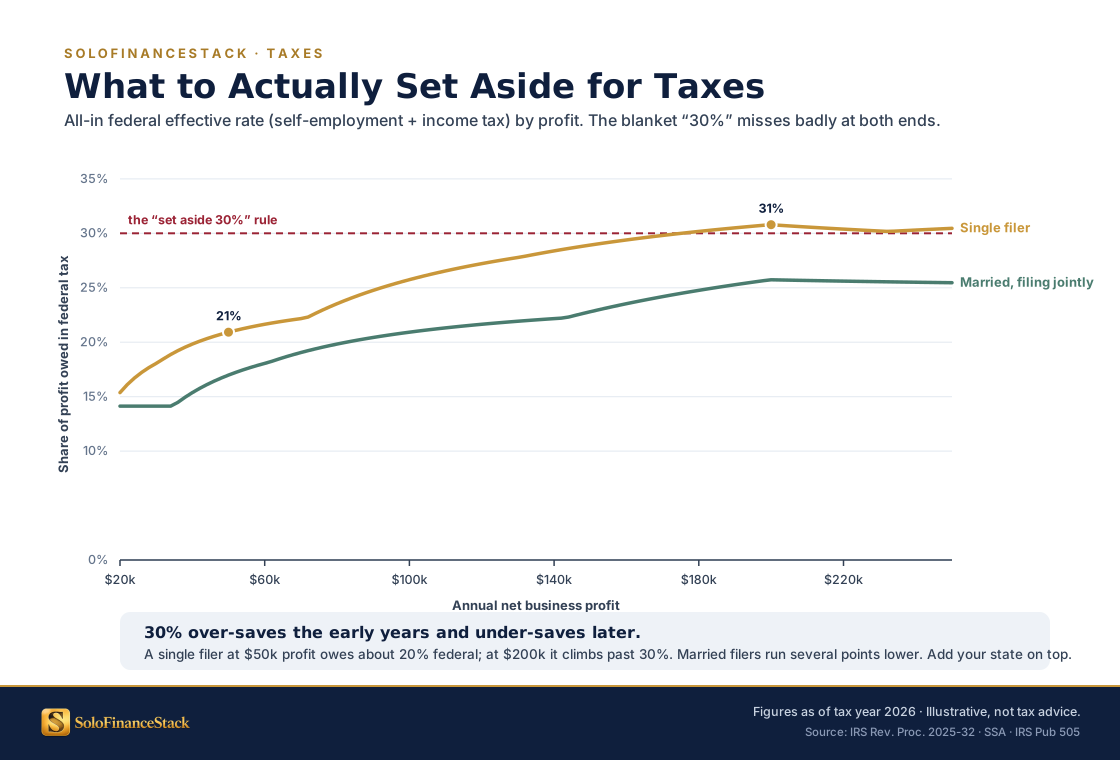
The quick answer
Why there's no single right answer
Unlike W-2 employees whose withholding is calculated precisely for their situation, freelancers have to estimate their own. The right percentage varies based on:
- Your net profit — higher income pushes you into higher brackets
- Filing status — single filers pay more than married filing jointly at the same income
- Business deductions — home office, health insurance, retirement contributions, software, and other deductible expenses reduce your taxable net profit meaningfully
- State taxes — ranges from 0% (no income tax states) to 13.3% (California top rate)
- Entity structure — S-Corp election changes the calculation significantly at higher income levels
The 30% rule works as a starting default because it's conservative enough to cover most situations at most income levels. If your actual tax bill ends up being 24% of revenue, you've been building savings. If it's 33%, you're covered. The cost of oversaving is a refund. The cost of undersaving is a scramble in April.
Set-aside percentages by income level
These estimates assume a sole proprietor filing single with standard federal income tax rates and typical business deductions. State tax is excluded — add your state rate on top.
| Annual Gross Revenue | Typical Net Profit* | Est. Federal Tax Burden | Recommended Set-Aside |
|---|---|---|---|
| Under $30K | $22–27K | ~$4,500–6,500 | 20–22% of gross |
| $30K – $60K | $24–52K | ~$7,000–14,000 | 23–25% of gross |
| $60K – $120K | $48–100K | ~$14,000–30,000 | 27–30% of gross |
| $120K – $200K | $95–165K | ~$30,000–55,000 | 30–32% of gross |
| $200K+ | $155K+ | $55,000+ | 33–35% of gross (consider S-Corp) |
*Net profit estimate assumes business expenses of ~10–15% of gross revenue. Your actual expenses may differ significantly. Use your actual net profit for a more accurate calculation — try the tax calculator.
What makes up your tax bill
There are two major components to your self-employment tax liability. Understanding both helps you calibrate your set-aside accurately.
15.3% × 92.35% of net profit. This is your Social Security (12.4%) and Medicare (2.9%) contribution — both halves, since you're your own employer. Applies to the first $168,600+ of net earnings for Social Security (verify current wage base each year). Medicare has no cap.
Progressive federal income tax on your net profit after deductions — including the 50% SE tax deduction and the QBI (Qualified Business Income) deduction if you qualify. Actual effective rate for most solo operators in the $60K–$150K range is 15–22%.
Adding state taxes to the calculation
Add your state's top marginal income tax rate to the federal calculation to get a combined set-aside target. Most states with income tax apply it to the same net profit base as the federal return.
| State Category | Examples | State Rate Range | Add to Federal |
|---|---|---|---|
| No income tax | TX, FL, NV, WA, WY, SD, AK | 0% | Add 0% |
| Low income tax | AZ (2.5%), CO (4.4%), IN (3.05%) | 2–4% | Add 2–4% |
| Mid income tax | GA, OH, VA, MA, NC | 4–6% | Add 4–6% |
| High income tax | NY (10.9%), NJ (10.75%), OR (9.9%) | 8–11% | Add 7–9% |
| Very high income tax | CA (up to 13.3%) | 10–13% | Add 9–11% |
State rates shown are approximate top marginal rates. Most solo operators in moderate income ranges face effective state rates 2–4 points below the top marginal rate. Verify your state's current rates at your state Department of Revenue website.
Use gross revenue for your set-aside, not net profit
A common mistake: calculating your tax allocation as a percentage of net profit rather than gross revenue. This seems more accurate — taxes are calculated on net profit, after all. But it creates a timing problem.
You know your gross revenue the moment a payment arrives. You don't know your net profit until you've paid all your bills for the period. If you wait to calculate the allocation until you know your net, you're making the decision in real time, subject to cash pressure, and the money may already be gone.
The practical solution: set aside a slightly higher percentage of gross revenue — 25–30% — and let the overcollection act as a buffer. If your business expenses are 20% of gross, your net profit is 80% of gross, and 30% of gross covers about 37.5% of net — more than enough for most tax situations. The overage becomes savings.
S-Corp election changes the math significantly
If your net profit exceeds roughly $80,000 annually, an S-Corp election can reduce your self-employment tax burden substantially. The mechanism: an S-Corp pays you a "reasonable salary" as an employee, and only the salary portion is subject to payroll tax (equivalent to SE tax). The remaining profit flows through as a distribution and avoids the 15.3% SE tax.
As sole proprietor: SE tax on 92.35% × $150K = ~$21,200. Plus income tax.
As S-Corp: Pay yourself $80K salary. Payroll tax on salary = ~$12,240. The remaining $70K flows as distribution — no SE tax. Total FICA: ~$12,240 vs $21,200.
Potential savings: ~$9,000/year. Offset by S-Corp administrative costs (payroll service, separate tax return) of $1,500–3,000/year. Net savings at this income: $6,000–7,500 annually. Talk to a CPA before electing — the savings depend on your specific situation.
Deductions that reduce your taxable income
A higher set-aside percentage is the safe default. But strong deductions can lower your actual tax bill significantly, which means a lower percentage is sufficient. Key deductions for solo operators:
- Home office deduction — proportional share of rent/mortgage, utilities, and internet for a dedicated workspace. Actual-expense method or simplified method ($5/sq ft, up to 300 sq ft).
- Health insurance premiums — 100% deductible as self-employed health insurance if you're not eligible for employer coverage through a spouse
- Retirement contributions — SEP-IRA contributions (up to 25% of net self-employment income, max $69,000 in 2024), Solo 401(k) contributions (verify current limits). Massive deductions at higher income levels.
- Business tools and software — FreshBooks, QuickBooks, project management tools, design software, CRM, etc.
- Professional development — courses, books, conferences, certifications directly related to your work
- 50% of SE tax — directly deductible from gross income (already factored into standard tax calculations)
- QBI deduction (Section 199A) — up to 20% of qualified business income for eligible businesses
Working with a CPA who specializes in self-employed clients is the highest-ROI financial decision many solo operators can make. Their fee is deductible, and they typically find deductions that more than cover their cost.
How to automate the set-aside
The goal is to remove the set-aside from your decision-making entirely. Every time revenue arrives, a fixed percentage should move to a tax account automatically — before you see it, before you spend it, before you can rationalize using it for something else.