
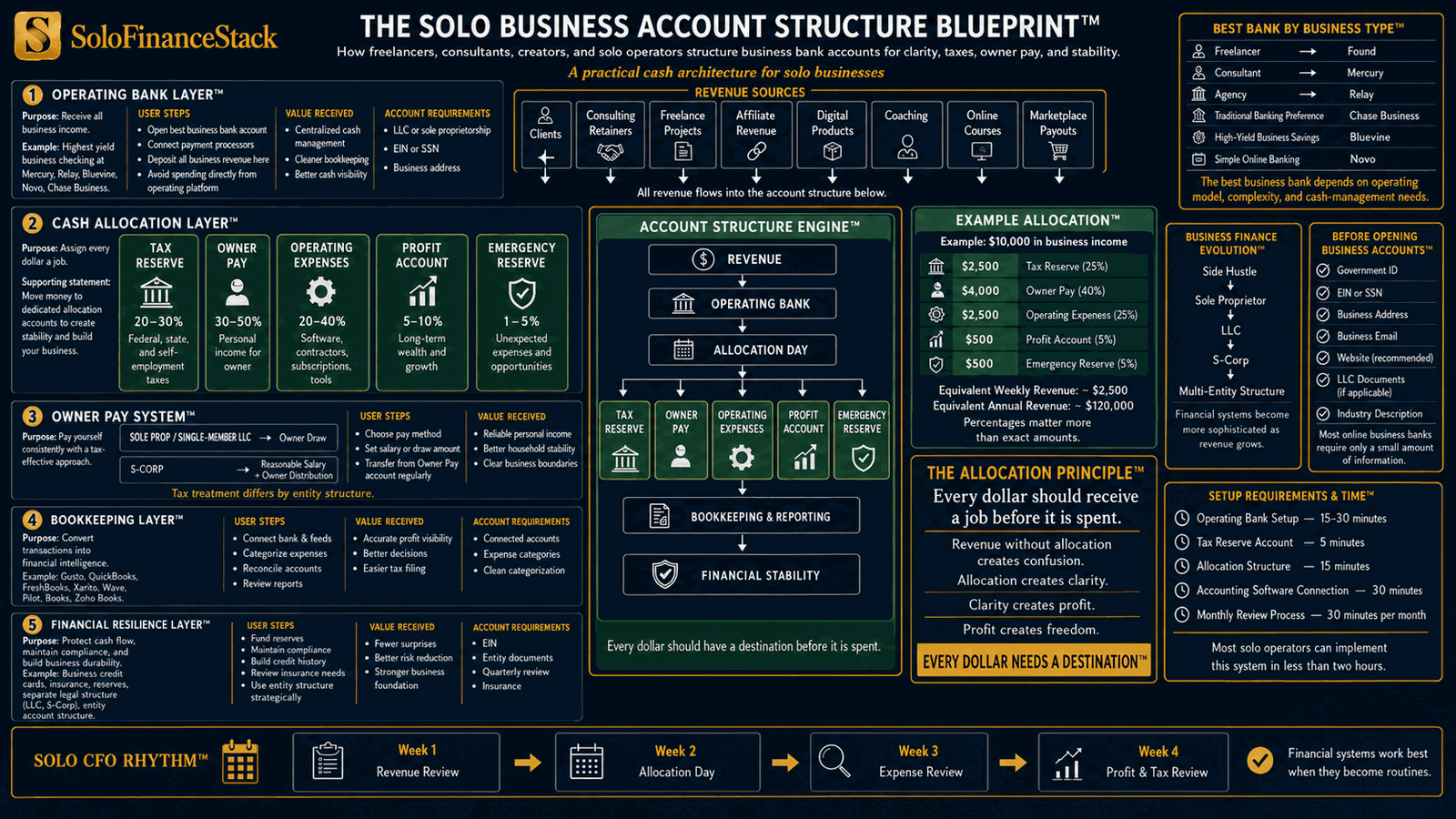
Three account models
The question of how many business bank accounts to maintain has a definitive answer: as many as solve your specific problems, and no more. Complexity without purpose creates overhead. Too few accounts and you lose visibility. Here are the three models and when each one is appropriate.
The decision framework
Model 1: One Account
Setup: One dedicated business checking account (Mercury or Relay, free). All income lands here. All business expenses paid from here.
Works for: Pre-revenue operators, side hustles generating under $1,000/month, or operators who track taxes via a spreadsheet and have the discipline to maintain a mental tax allocation.
The limitation: When all money is in one account, you make decisions based on the total balance — not on what's actually available after taxes. Most operators who stay on the 1-account model eventually get blindsided by a tax bill.
Model 2: Three Accounts
Setup: Operating checking + Tax savings (25–30% auto-transfer) + Reserve savings (10–15% auto-transfer until funded).
Works for: Most solo operators earning $25K–$150K annually. Covers the two most critical allocations (taxes and reserve) without requiring the complexity of full Profit First.
Best bank for this model: Relay gives you three real sub-accounts at no cost with automatic transfer rules. Mercury works too — checking for operating, savings for taxes, savings for reserve — but requires manual transfers or Zapier automation.
Model 3: Five Accounts
Setup: Income (pass-through) + Profit + Owner's Pay + Taxes + Operating + Reserve. Six accounts total in Relay's sub-account system, all free.
Works for: Operators earning $50K+ annually who want systematic cash management, operators following Profit First, and anyone who works with a bookkeeper who benefits from seeing clear account separation.
The advantage: Every dollar is allocated automatically on arrival. You never ask "do I have money for this?" — you check the Operating account balance and that's your answer.