The Framework

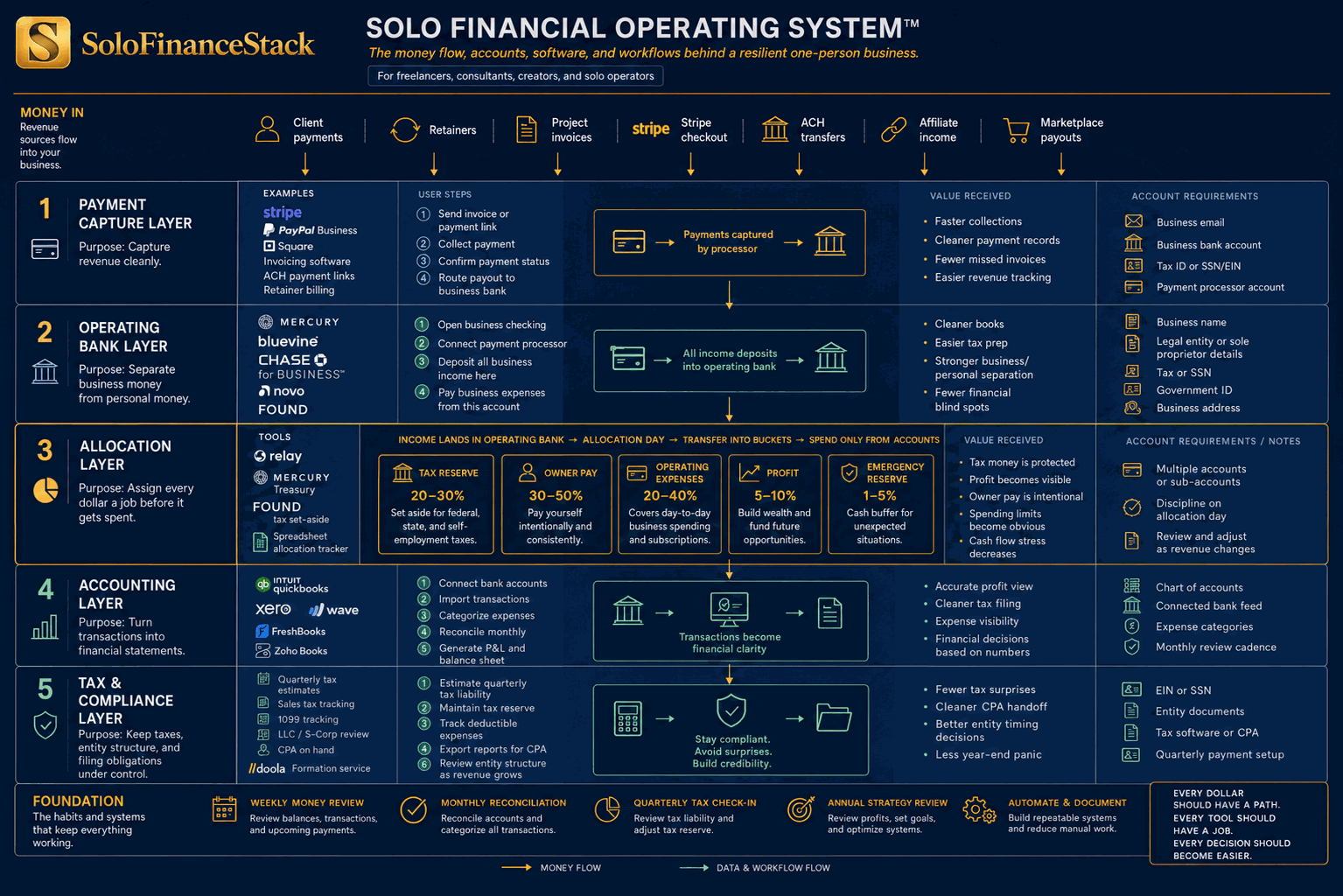
Eight layers. Each one unlocks the next.

You can't optimize a layer you haven't built. The sequence matters — and most solo operators are missing layers 3–5 entirely.

Layer 1
Revenue Capture
What it does: Ensures every dollar you earn arrives in a dedicated business account, tracked from the moment it arrives. Without it: Mixed personal/business income creates tax liability, no banking history, and zero foundation for every subsequent layer. Tools: Mercury or Relay business checking. FreshBooks for invoicing and payment collection.
MercuryRelayFreshBooks
Layer 2
Banking Architecture
What it does: Structures your bank accounts so money allocates automatically to taxes, reserves, and operating expenses on arrival — without requiring manual discipline. Without it: One account balance creates false confidence about available cash. Tax bills feel like emergencies. Slow months create cash pressure. Tools: Relay sub-accounts with automatic transfer rules. 3-account model minimum; 5-account for Profit First.
Relay sub-accountsAuto-transfer rules
Layer 3
Accounting System
What it does: Tracks every business transaction, categorizes expenses, generates accurate financial reports, and provides the records your CPA needs for taxes. Without it: No visibility into profitability, no audit trail, manual year-end reconstruction that costs CPA hours, missed deductions. Tools: FreshBooks Plus for service billing. QuickBooks for S-Corps and complex needs. Wave Pro for early stage.
FreshBooksQuickBooksWave Pro
Layer 4
Cash Allocation
What it does: Ensures every dollar is allocated to its purpose on arrival — not at month end, not when you remember. Taxes, profit, owner's pay, and operating budget are automatically separated. Without it: Reactive spending, tax surprises, no operating reserve, irregular owner compensation. Tools: Relay automatic transfer rules. The Profit First account structure. Operating reserve target: 60 days of expenses.
Relay rulesProfit First
Layer 5
Tax Management
What it does: Eliminates tax surprises through automatic allocation, quarterly estimated payments, and proactive planning with a CPA. Without it: Annual April surprises, underpayment penalties, missed deductions, reactive decisions instead of strategic ones. Tools: Dedicated tax savings account (25–30% of every deposit). Quarterly estimate calendar. Annual CPA planning session.
Tax savings accountCPA quarterly review
Layer 6
Business Credit
What it does: Builds a business credit profile separate from personal credit — enabling access to business financing on business terms, not personal guarantees. Without it: No access to business credit, personal credit exposed to business risk, no funding options without personal guarantee. Tools: Nav for credit monitoring. Business cards that report to bureaus. Net-30 vendor accounts. 12–18 months to build.
NavChase InkNet-30 accounts
Layer 7
Planning
What it does: Creates a regular cadence of financial review — monthly close, quarterly CPA review, annual planning — so decisions are made with current data rather than instinct. Without it: Reactive financial decisions, missed optimization opportunities, no visibility into trends until problems are severe. Tools: Monthly 15-minute P&L close. Quarterly CPA meeting. Annual stack audit (re-run the financial stack builder each January).
Monthly closeQuarterly CPAAnnual audit
Layer 8
Growth Capital
What it does: Provides access to business financing — credit lines, term loans, revenue-based financing — when you need capital to grow without diluting equity or relying on personal savings. Without it: Growth limited to what current revenue can fund. No buffer for expansion investments. Opportunity cost of slow organic growth. Tools: Lendio for marketplace matching. Fundbox for early-stage lines of credit. Mercury Venture Debt for qualifying operators.
LendioFundboxMercury Venture Debt
Financial Capabilities

Capability → Outcome

Each layer of the financial OS creates a specific capability that produces a specific outcome. Here's the map.

👁️
Cash Visibility
→ Confidence
Layer 2 + 3
When you can see exactly how much is operating cash vs. taxes vs. reserve, you make decisions with clarity instead of anxiety.
🛡️
Reserve Systems
→ Resilience
Layer 4
A 60-day operating reserve transforms slow months from crises to inconveniences. You negotiate from strength because you're not desperate.
⚙️
Automation
→ Capacity
Layer 1 + 4
Every automated financial task is time returned to billable work. The financial OS runs without you — freeing you to build the business.
📊
Credit Profile
→ Optionality
Layer 6
Business credit built over 12–18 months opens doors: credit lines on business terms, equipment financing, vendor net-30 accounts. Options you didn't have before.
🗓️
Planning Cycle
→ Growth
Layer 7
Regular financial review converts data into decisions. Annual planning with a CPA surfaces tax strategies, investment opportunities, and upgrade triggers you'd otherwise miss.
💰
Capital Access
→ Scale
Layer 8
When growth requires capital — hiring, equipment, market expansion — access to business financing at business rates means you can move without personal risk.
🔬
10-Question Diagnostic
Assess My Financial OS
Score your system across 10 capability dimensions. Get your current level, gap analysis, and a specific upgrade path with tool recommendations.
🏗️
Evolution Pathway
Financial Architecture
Freelancer → Consultant → Agency → Advisor → Scaled. Find your stage and the architecture that fits it.

Not sure where your financial OS stands?
Assess My Financial OS → Build My Stack