 By Jared White · Executive MBA, AI for Business Certified
How the S-Corp election works
As a sole proprietor or single-member LLC, every dollar of net profit is subject to the full 15.3% self-employment tax (on 92.35% of net profit). This covers both the employee and employer share of Social Security and Medicare. On $150,000 of net profit, that's roughly $21,200 in SE tax before you even calculate income tax.
An S-Corp changes this by splitting your income into two buckets: a salary (subject to payroll tax, which is equivalent to SE tax) and distributions (not subject to payroll tax). By setting a reasonable salary below your total net profit, you reduce the amount of income subject to the FICA taxes — and save the difference.
As sole proprietor/default LLC:
SE tax on $150K × 92.35% × 15.3% = ~$21,200
As S-Corp with $80,000 reasonable salary:
Payroll tax on $80K salary = ~$12,240
Distributions of $70K = no payroll tax
Total FICA: ~$12,240
Gross savings: ~$8,960/year
Less S-Corp costs (payroll service + extra CPA work): ~$2,000/year
Net savings: ~$6,960/year
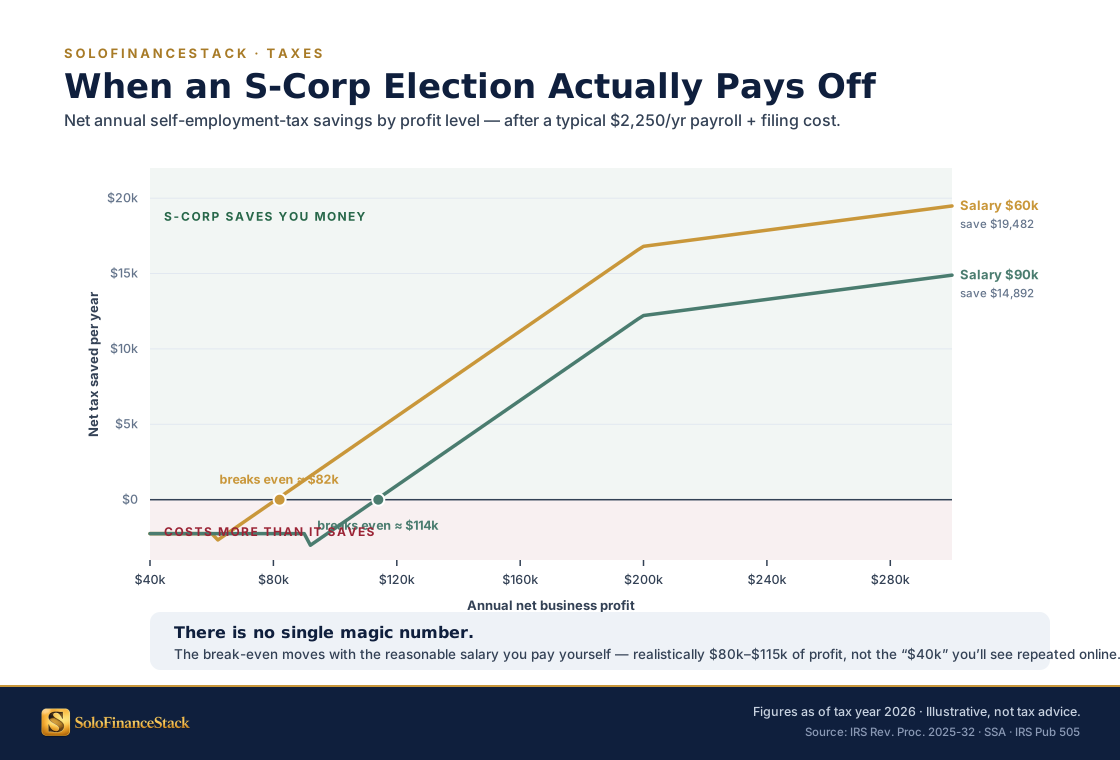
The income threshold — when it actually makes sense
The S-Corp election creates real administrative overhead: you must run payroll, file a separate S-Corp tax return (Form 1120-S), and generally spend more on CPA fees. Those costs typically run $1,500–$3,000 per year for a solo operator. The election only makes financial sense when your SE tax savings exceed those costs.
| Net Annual Profit | Est. SE Tax Savings | Est. S-Corp Admin Costs | Net Annual Benefit | Verdict |
|---|---|---|---|---|
| Under $60K | $0–$2,000 | $1,500–$3,000 | Negative | Not worth it |
| $60K–$80K | $2,000–$4,000 | $1,500–$3,000 | Break-even | Marginal — evaluate carefully |
| $80K–$120K | $4,000–$8,000 | $2,000–$3,000 | $2,000–$5,000 | Makes sense — consult a CPA |
| $120K–$200K | $8,000–$14,000 | $2,000–$3,000 | $6,000–$11,000 | Clearly worth it |
| $200K+ | $14,000–$20,000+ | $2,500–$4,000 | $10,000–$16,000+ | Do this immediately |
Estimates based on 2026 SE tax rates and typical S-Corp administrative costs for solo operators. Savings assume reasonable salary of approximately 50–60% of net profit. Actual numbers depend on your specific situation, state taxes, and salary determination. Consult a CPA for your actual numbers.
The key caveat for consultants specifically: consultants can often justify higher reasonable salaries (60–80% of income) because of specialized expertise and client-facing work, which means less income is available as distributions. This reduces the tax savings relative to other business types. Consultants should typically target $80,000–$100,000 in net annual income before the election makes strong financial sense.
The reasonable salary requirement — the most important rule
The IRS requires S-Corp owner-employees to pay themselves "reasonable compensation" — what you would pay someone else to do your job. This is not a fixed formula or percentage. The IRS defines reasonable compensation as the amount ordinarily paid for similar services by similar organizations in similar circumstances.
Setting your salary too low is the most audited aspect of S-Corp returns. The IRS has aggressively pursued cases where owners tried to pay minimal salary to maximize tax-free distributions. The IRS will reclassify excessive distributions as salary and assess back taxes plus penalties.
The Form 2553 deadline — do not miss this
The S-Corp election is made by filing Form 2553 with the IRS. Form 2553 must be filed by March 15 for current year effectiveness — this is just 2 months and 15 days into the year. Missing this deadline means your election is effective for the following tax year, costing you a full year of potential savings.
If you missed the 2026 deadline, late election relief exists under IRS Revenue Procedure 2013-30 — but it requires showing reasonable cause. A CPA can help assess whether you qualify. In most cases, the simpler path is to plan for the 2027 election and use the current year to set up the infrastructure.
What running an S-Corp actually requires
The administrative overhead is real and is the main reason the election doesn't make sense at lower income levels.
- Payroll service — Gusto ($46–$80/month for solo S-Corp) or QuickBooks Payroll. You cannot skip payroll — you must process it regularly throughout the year.
- Separate S-Corp tax return (Form 1120-S) — filed by March 15 (calendar year companies). CPA cost: typically $500–$1,500 on top of your personal return.
- Payroll tax deposits — employer and employee payroll taxes must be deposited with the IRS on a schedule (semi-weekly or monthly depending on liability). Your payroll service handles this automatically.
- W-2 to yourself — you receive a W-2 from your own S-Corp at year-end. Your personal return then shows both W-2 income and S-Corp distributions.
- Reasonable salary documentation — written compensation analysis, documented annually, showing how you determined your salary. Keep this on file in case of audit.
- QuickBooks or Xero — strongly recommended — the additional complexity of tracking salary vs. distributions, payroll liability accounts, and shareholder basis makes proper accounting software non-optional for S-Corps.