The Verdict Up Front: Which Account Should You Open?
If you are a self-employed freelancer, consultant, or solo operator earning meaningful net income and you have no full-time employees, the Solo 401(k) wins in almost every scenario where you want to maximize your tax shelter. It offers higher effective contribution limits at moderate income levels, a Roth option, and loan provisions that the SEP-IRA simply does not have.
The SEP-IRA earns its place in one narrow but important lane: you missed the December 31 setup deadline, your income is highly variable and you want zero plan maintenance, or you are testing retirement savings for the first time with minimal friction. It is a legitimate account — just not the default best choice for most solos who run through the real math.
Below is the full breakdown: contribution mechanics, scenario math, a side-by-side table, and the exact income levels and life situations where each account comes out ahead.
Who This Comparison Is For (and Who Should Stop Reading Here)
This guide is written for business-of-one operators: freelancers, consultants, creators, and independent contractors who file Schedule C or run a single-member LLC taxed as a sole proprietor or S-corp. If you have full-time employees, neither of these plans scales with you — you will need a SIMPLE IRA or a traditional 401(k) with a third-party administrator. If you are a W-2 employee with a side hustle, parts of this apply but the math gets layered — flag it for your CPA.
How Each Account Actually Works
Solo 401(k): Two Buckets, One Account
The Solo 401(k) — sometimes called an Individual 401(k), a Self-Employed 401(k), or a one-participant 401(k) — lets you contribute in two distinct roles simultaneously: as the employee and as the employer.
As the employee, you can defer up to 100% of your net self-employment compensation, up to the annual elective deferral limit. As of mid-2026, confirm the current limit at IRS.gov, as it adjusts annually for inflation. On top of that, your business can make an employer profit-sharing contribution of up to 25% of your W-2 compensation (if you are an S-corp) or approximately 20% of your net self-employment income (if you are a sole proprietor or single-member LLC — the exact percentage reflects the deduction adjustment for self-employment tax).
The combined total of both contributions cannot exceed the overall annual addition limit — currently in the range of $69,000-$70,000 for those under 50 as of mid-2026, plus a catch-up amount for those 50 and older. Verify the live number before contributing.
Critically, many Solo 401(k) providers now offer a Roth election, meaning you can direct some or all of your employee deferrals into an after-tax Roth bucket. That flexibility is unavailable in a SEP-IRA.
SEP-IRA: Simple Math, No Employee Deferral
The SEP-IRA (Simplified Employee Pension) works entirely on the employer contribution side. There is no employee deferral component. You can contribute up to 25% of eligible compensation (or roughly 20% of net self-employment income for sole proprietors after the SE tax deduction) up to the same overall annual cap that applies to the Solo 401(k).
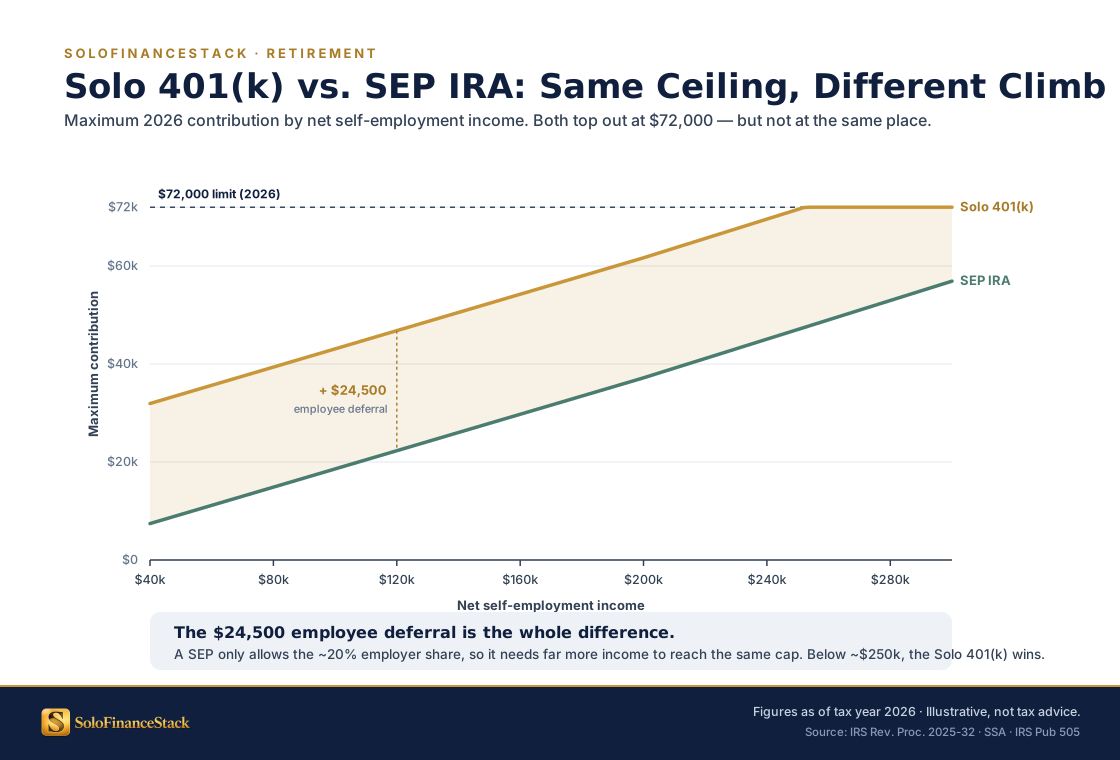
Because there is no employee deferral piece, you need significantly higher income to reach the same contribution cap as a Solo 401(k). The account lives at a standard IRA custodian, setup is fast, there are no plan documents, and it can be opened up to your tax filing deadline including extensions — that last point is a genuine, practical advantage.
The Original-Axis Comparison: $60K Freelancer vs $140K Consultant
Generic feature lists obscure the real decision. The numbers below illustrate the mechanics — use them as a model, then run your own figures with a CPA or tax software. Assume sole proprietor filing, no other retirement plans, under age 50, and approximate figures for illustration based on general IRS formula mechanics.
| Scenario | Net SE Income | Max SEP-IRA Contribution | Max Solo 401(k) Contribution | Advantage |
|---|---|---|---|---|
| Early-stage freelancer | $60,000 | ≈ $11,100 | ≈ $30,100 | Solo 401(k) by ~$19,000 |
| Mid-level consultant | $100,000 | ≈ $18,600 | ≈ $41,100 | Solo 401(k) by ~$22,500 |
| High-earning consultant | $140,000 | ≈ $26,100 | ≈ $49,600 | Solo 401(k) by ~$23,500 |
| Very high earner | $250,000+ | Both hit the plan cap | Both hit the plan cap | Converges at the ceiling |
The pattern is clear: at moderate income levels — the $60,000-$150,000 range where most freelancers operate — the Solo 401(k) shelters dramatically more income because the employee deferral component lets you front-load contributions before the percentage-based employer math even kicks in. The gap only closes when income is high enough that the 20-25% employer contribution alone reaches the plan ceiling.
These figures are illustrative approximations. Actual maximums depend on the exact SE tax deduction, your compensation structure, and the live IRS limits for the year. Run the specific numbers with a tax professional before making elections.
Roth Access: A Factor That Changes the Long-Term Math
Tax diversification in retirement — having both pre-tax and after-tax buckets — is increasingly valuable as tax rates remain uncertain. A Solo 401(k) with a Roth election lets you build a tax-free withdrawal bucket while still capturing the employer profit-sharing contribution on the pre-tax side.
A SEP-IRA offers no Roth path. Every contribution is pre-tax, every withdrawal in retirement is ordinary income. For solos who expect their income — and potentially their tax rate — to rise over time, the Roth option inside a Solo 401(k) could be worth more than the simplicity premium of the SEP-IRA. This is a long-horizon projection, not a certainty — a CPA or fiduciary advisor can help you model the after-tax comparison against your specific income trajectory.
Setup, Maintenance, and Administrative Reality
Honest limitation check: the Solo 401(k) carries more operational weight.
You must establish the plan by December 31 of the tax year you want contributions to count. Once your plan assets exceed $250,000, you are required to file Form 5500-EZ annually with the IRS. Plan documents are longer. Some providers charge annual fees for Solo 401(k) plans that they do not charge for IRAs.
The SEP-IRA is genuinely frictionless: fill out IRS Form 5305-SEP or your custodian's one-page equivalent, open the account, and contribute any time before your filing deadline. There is no annual filing requirement regardless of account balance. For a freelancer in a chaotic first year who just wants to do something before tax day, this accessibility is real value.
The Deadline Difference: Often the Deciding Factor
If you are reading this in the first half of the calendar year thinking about last year's taxes, the Solo 401(k) ship may have already sailed. The account must have been established by December 31 of the prior tax year to accept contributions for that year.
A SEP-IRA can be opened today and funded retroactively for last tax year, as long as you have not yet filed (or filed with an extension still open). For solos who procrastinate on retirement savings — which is most of us — this flexibility is the SEP-IRA's most practical selling point. Pair your SEP-IRA contribution with your estimated tax review using the framework in our Quarterly Estimated Tax Guide to coordinate the cash flow timing.
How This Fits Your S-Corp Structure
If you have elected S-corp status for your freelance business, the mechanics shift slightly. Your employee deferrals are based on your W-2 salary from the S-corp, not your net SE income. The employer profit-sharing contribution is also calculated on W-2 wages. This means the salary you set matters for retirement contributions — another reason the S-corp election decision and your retirement strategy should be modeled together, not in isolation.
Under an S-corp structure, the SEP-IRA contribution limit is also calculated on W-2 compensation, which means if you are paying yourself a moderate salary to minimize payroll taxes, your SEP-IRA ceiling drops alongside it. The Solo 401(k) remains the stronger shelter for S-corp solos at most salary levels because the employee deferral layer is not capped by your employer contribution percentage.
Where Each Account Fits in Your Financial OS
Both accounts live in the Growth layer of the Solo Financial OS — they are wealth-building tools, not operational infrastructure. But they interact with the other layers in distinct ways.
The Solo 401(k) pairs best with a clean business banking setup (see our guide to best business checking accounts for solos) and a disciplined tax-withholding habit, because the higher contribution ceiling means you need to actually have cash available to deploy. Maxing a Solo 401(k) requires cash planning, not just intent.
The SEP-IRA pairs well with variable-income freelancers who keep their financial infrastructure simple. Its contribution is entirely discretionary and calculated after the year ends, so you contribute what you can rather than committing to a schedule. Understand how deductions feed into this calculation by reviewing the self-employed tax deductions guide — your net SE income after legitimate deductions is the base on which SEP-IRA and Solo 401(k) employer contributions are calculated.
Skip-It-If: When Each Account Is the Wrong Choice
Skip the Solo 401(k) if...
You have or plan to hire a full-time employee in the next 12 months. The plan must be terminated or restructured the moment a qualifying employee is added, and that transition creates administrative work and potential compliance exposure. You should also skip it if you missed the December 31 establishment deadline and need to shelter income for the prior tax year — the window is closed.
Skip the SEP-IRA if...
You are earning more than roughly $50,000-$60,000 in net self-employment income and you want to maximize your retirement contribution. At that income range, leaving the employee deferral opportunity unused means potentially leaving $20,000+ of tax-deferred space on the table annually. Over a decade, that gap compounds into a material difference in retirement assets. The SEP-IRA is not a bad account — it is just a low-ceiling one for most freelancers who can qualify for the Solo 401(k).
Bottom Line: The Decision Tree in Plain English
Start here: Did you establish a Solo 401(k) before December 31 of the tax year in question? If no, open a SEP-IRA before your filing deadline and move on. If yes, or if you are planning ahead for the current year: do you have any full-time employees? If yes, neither account applies — talk to a plan administrator. If no, open or maintain your Solo 401(k), elect Roth if your tax situation favors after-tax contributions, and contribute the maximum your cash flow supports.
The Solo 401(k) is the better vehicle for the overwhelming majority of solo operators earning between $50,000 and $250,000 in net self-employment income. The SEP-IRA is a legitimate fallback and a genuine winner for the procrastinator who needs to act before April. Neither replaces a conversation with a CPA or enrolled agent about how retirement contributions interact with your specific income, deductions, and entity structure — but you now have the framework to make that conversation productive. Start with the Financial OS Stack blueprint to see how your retirement layer connects to the rest of your solo money system.